Let me get the conflict of interest out of the way first. I work in a family office. I have spent my career helping people decide whether they need professional financial help, and the answer I am about to give you is "probably yes." You should read the rest of this knowing that I am, in a sense, advertising my own industry.
I am going to try to earn your trust anyway, by being honest about when you need an advisor, when you don't, and what to actually look for if you decide you do.
Why my clients are a different animal
The families I work with do not have a money problem you can solve on your phone. They have estates large enough to be taxable, which means every dollar above the exemption can be cut by roughly forty percent on its way to the next generation. They have operating businesses, concentrated stock positions, partnership interests, real estate across multiple states, and trusts layered on top of trusts. That complexity is not a bug. It is the natural result of building real wealth over a lifetime, or many lifetimes for some families.
That is why those clients have a team. A good one includes Certified Public Accountants (CPAs), attorneys, Chartered Financial Analysts (CFAs), Certified Financial Planners (CFPs), and MBAs, all coordinating so the left hand knows what the right hand is doing. If you think that is a lot of acronyms, you are beginning to understand the problem. It sounds expensive because it is. But when you have a taxable estate, the cost of administering it well is paid back many times over in taxes you legally never owe. A missed election, a botched trust funding, a sale timed badly against a tax year, and the damage runs into seven figures. The fee is not the expense. The mistake is the expense. For this kind of client, doing it yourself is not thrifty. It is reckless.
But that is almost certainly not you. So let me talk about you.
For the rest of us, it is more manageable than the industry admits
If your financial life is normal, the tools have gotten remarkably good. You can buy a diversified index fund on your phone in about ninety seconds. You can file a perfectly correct tax return with TurboTax. You can sit down with an attorney once and walk out with the documents that actually matter: a revocable living trust, a will, a healthcare directive, a HIPAA waiver, and a durable power of attorney. That is most of the estate planning a typical family needs, and it is a few hours of work, not a lifelong engagement.
So I am not going to insult you by pretending you can't do this yourself. You can. The honest question is not "can you," it is "should you." And my answer, even after telling you that you can, is that you probably should get help. Here is why.
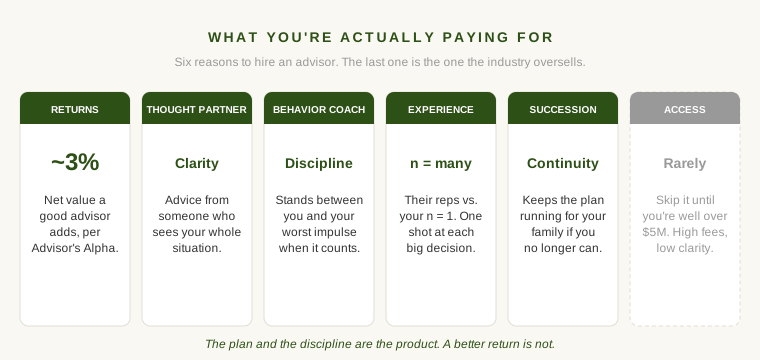
1. Returns
Start with the least romantic reason: the help often pays for itself. Vanguard has studied this for years under the banner of what they call Advisor's Alpha, and their estimate is that a good advisor can add about three percent in net value over time. Not from picking better stocks. From the unglamorous work: sensible asset location, disciplined rebalancing, spending down the right accounts in the right order, and keeping you from doing something dumb at the wrong moment.
Now be honest about the catch. That three percent is measured before what the advisor charges you. If someone adds three percent and bills one percent of your assets, you keep two. And their headline fee is rarely the only one. Underneath it sit the expense ratios of the funds they put you in, and sometimes a wrap fee layered on top, each quietly skimming a little more. Add every layer together before you decide what you are actually keeping. If the total costs more than the advisor adds, you are paying to lose ground. That subtraction is the whole game, which is why a fee has to be transparent enough for you to actually do the math.
And notice where the three percent comes from. None of it is beating the market. It is behavior and structure. That is exactly why the advisor who leads with market-beating returns is the one to walk away from. They are promising the one thing that almost never shows up, and skipping the things that reliably do.
2. A real thought partner
Big money decisions are easier when you can talk them through with someone. Your brother-in-law can be that person, and sometimes he is great. But there is a limit to how good his advice can be, because he doesn't actually see your full picture. He doesn't know your portfolio, your tax situation, your cash flow, the debt you are carrying, or the goal you are quietly working toward.
A good advisor sees all of it. When you ask "should I pay off the mortgage or invest the cash," they are answering with your actual numbers in front of them, not vibes and good intentions. Informed advice and friendly advice are not the same thing, and only one of them has your tax return open.
3. A behavior coach
This is the one people underrate the most, and it is probably the most valuable. Investing is not hard because the math is hard. It is hard because you are human. The market drops twenty percent and every instinct in your body tells you to sell. It rips twenty percent higher and every instinct tells you to pile in. Both instincts are wrong, and both are nearly impossible to override on your own.
This is measurable, not a hunch. Morningstar tracks the gap between what funds return and what the investors in those funds actually earn. Over the past decade the average investor trailed their own funds by about 1.2 percent a year, almost entirely from buying high and selling low. That gap compounds to roughly twenty percent less wealth over ten years. The single biggest job a good advisor does is stand between you and that mistake, talking you off the ledge in March and down off the rooftop in November. A plan you actually stick to beats a brilliant plan you abandon at the bottom, every single time.
4. Experience, or why your n equals one
I like home improvement projects. I am also bad at them the first time. I do the thing wrong, I learn why it was wrong, and the second time it comes out clean. The problem with your financial life is that there often isn't a second time. You get one retirement. You inherit money once. You sell the company once. You exercise the options once.
Your sample size is one. A professional has done this hundreds of times, across hundreds of families, in good markets and bad ones. They have already made the mistakes you are about to make, on someone else's behalf, years ago. You are not paying them to be smarter than you. You are paying for reps you will never get the chance to accumulate yourself.
5. Succession, the reason even the experts need help
I have been telling you that you can do most of this yourself, and some of you can do it exactly right. You will read the books, build the spreadsheet, automate the contributions, and run a plan as clean as anything I would draw up. If that is you, I am genuinely impressed. I am also going to point at the one problem your competence cannot solve.
The plan lives in your head. That makes you the single point of failure. If you have a stroke, slide into cognitive decline, or simply die first, everything you built has to be carried by someone else, on what may be the worst day of their life. Does your spouse know how the accounts fit together, which one to spend down first, when to rebalance, and what not to panic-sell in a crash? Do the people counting on you have a plan, or just a login and a prayer?
A durable power of attorney moves the authority, but someone still has to actually run the strategy. An advisor is that continuity. They keep executing the plan when you no longer can, so your spouse and everyone depending on you stays covered whether you are at the table or not. The most disciplined do-it-yourselfer I know still hired one for exactly this reason. He didn't need help managing the money. He needed the money to keep being managed if he wasn't there to do it.
6. Access, the seductive one to be careful with
Here is the reason the industry loves to lead with, and the one I want you to be most skeptical of: access. The pitch is that an advisor gets you into private deals, hedge funds, and exclusive investments you could never reach on your own.
Access can be real. For someone genuinely sourcing private opportunities, the right relationships matter. But for almost everyone, it is the most dangerous reason to hire someone, because it is sold as a privilege and it often delivers high fees, low transparency, and risk you don't fully understand. Honestly, access does not start to matter until your portfolio is well over five million dollars. Below that, investing is essentially commoditized. The same low-cost index funds available to a pension fund are available to you on your phone, for the same price.
Which means the real value of a planner, for the overwhelming majority of people, is not a secret door. It is the plan, the thinking, and the discipline. If an advisor's main pitch is the secret door, hold onto your wallet.
So how do you pick one
If you have read this far and decided you want help, screen hard on three things. Transparent fees, which in practice means looking for two words: fee-only and fiduciary. A fee-only advisor is paid by you and only you, with no commissions for nudging you into products, and a fiduciary is legally bound to put your interests ahead of their own. Both are the opposite of a commission-based broker, whose paycheck depends on what they sell you. Insist on them, so you can actually do the subtraction from a few paragraphs ago. Real tax planning, because for most families taxes are the largest controllable expense over a lifetime, and the account order and asset location are where a lot of that quiet three percent actually lives. And genuine long-term planning, the kind that starts with your goals and works backward, rather than starting with a product.
Notice what that list is really screening for. It is reasons two through five: a thought partner who sees your whole picture, a coach who keeps you in your seat, someone with the experience to plan around taxes you would never catch, and the continuity to keep the plan running if you no longer can. It is not screening for a better return. The advisor promising to beat the market is selling the one thing they almost certainly cannot reliably deliver, and distracting you from the things they actually can.
That is the most self-serving advice I will ever give you. It also happens to be true. If you want to know what the good ones spend their time on once you've hired them, I wrote about what good advisors actually do.